The board / Ready
Restore the hidden word: damaged Latin inscriptions
Demo calibration run. Unverified. Not yet reviewed by an epigrapher. Every hidden word is already known, so this measures how well a model restores Latin. It is not a discovery.
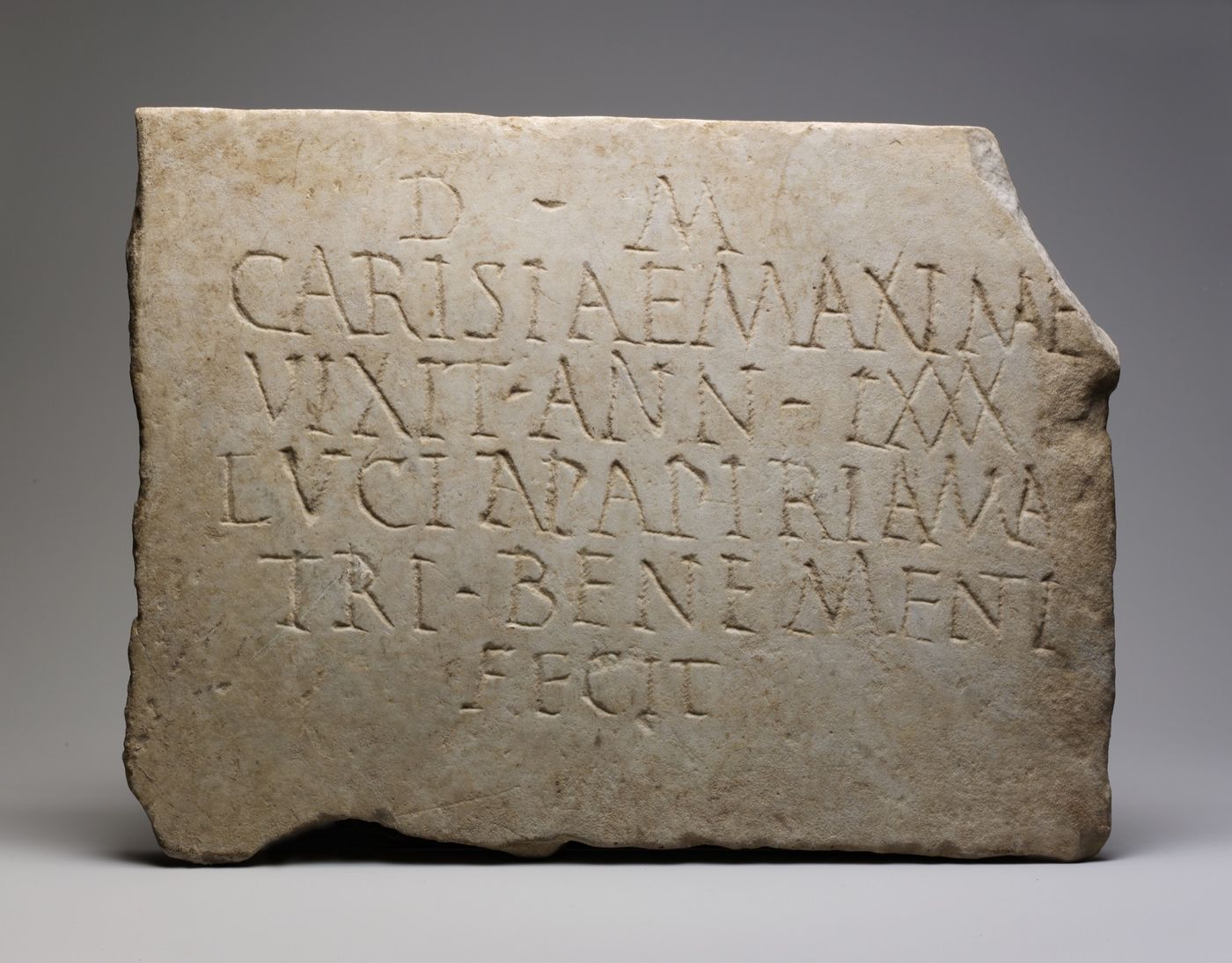
Most Roman inscriptions survive broken or worn, and restoring a lost word is slow expert work. This pack tests a small, checkable version of it. One word that is carved on the stone, and read with certainty, is hidden in each inscription. The model sees the rest of the text and the word's letter count, and gives up to three guesses. A script scores them.
The latest run
- 91/200right on the first guess (46%)
- 99/200right within three guesses (50%)
- 0/50inscriptions recited from the catalogue number alone
- 7tasks flagged as a pack bug, kept in the score. Without them: 91/193
What the model sees
M(arco) Licinio Probo dec(urioni) qui vixit n(os) L M(arcus) [8 letters] Severus patri optim(o)
Why recall is on the scoreboard
This data has been public for decades, so models have likely seen it. Before seeing any task, the model is given 50 catalogue numbers alone and asked to recite each inscription. That number sits beside the score. A zero doesn't prove the model never saw the data: it can know a text without knowing its number. A stronger test is coming in the next task set.
What we know is wrong
- 7 of the 200 hidden "words" are strings of letters the editors could not interpret, such as ICOIILA. No one could restore them. They're flagged and kept in the score, and the next task set excludes them.
- 11 texts carry the database's raw variant notation, which makes them noisy to read.
- A word spelled the carver's way (Ponpeius) is scored as missed when the guess has the standard spelling (Pompeius). Whether that's right is a question for an epigrapher.
- The answer key is public. It sits in the same repository as the tasks, and the agent is only told not to open it. So a run's score rests on the operator's word, and the recall test is the one check on it. A private answer set comes with the full protocol.
- This run was done by the same Claude session that built the pack. The answer key was written by script and not opened before scoring, but it is not an independent run.
The full failure log. The locked method.
Run it with your own AI
Any model, any agent. Point it at the pack folder and tell it to follow AGENT.md. It does the recall test, then the 200 tasks, then scores itself with a script. Send the run folder as a pull request, and a check rescores it before it goes on this page. Every run you send is published, labeled unverified.
Use your AI company's own app. Run the pack inside the official tool your plan comes with, such as Claude Code, Codex or Gemini CLI, with you at the keyboard. Don't hand your subscription login to any other tool, including one of ours. We will never ask for it. Each company sets its own terms, and they change, so read yours.
This pack is also the public practice set for ScribeBench, a benchmark in development.
The data
The Epigraphic Database Heidelberg: about 81,000 Latin and bilingual inscriptions of the Roman Empire, recorded from 1993 to 2021 by the Heidelberg Academy of Sciences and Humanities and now kept by Heidelberg University Library. It is open under CC BY-SA 4.0, and so is everything this pack derives from it. Scholars there did the work that makes this checkable.